Why Portfolio Intelligence Has to Start at the Front Door
Work intake is the front door to the project portfolio, and it determines the composition of everything that follows. If the wrong work gets through the door, no amount of downstream discipline will fix it. You can have excellent status reporting, a well-run steering committee, and a disciplined portfolio scoring model, and still end up with an overloaded, low-value portfolio simply because the intake process let too much of the wrong work in.
This is why Work Intake Intelligence is the first of the five pillars of Portfolio Intelligence in Acuity PPM. The highest-leverage moment in project portfolio management is not during execution — it is the decision about what to execute, when, and with whom. Once a project starts, sunk costs accumulate, political pressure builds, and reversing the decision becomes expensive. Intake is the last moment where a bad decision is still cheap.
The problem is that most organizations know this and still cannot fix it, because the constraint is not a lack of conviction. It is a lack of capacity. The people submitting requests are the least familiar with the PMO’s process, and the PMO does not have the analyst bench strength to compensate.
“Intake is the last moment where a bad decision is still cheap. Everything after that is damage control.”
The Real Problem with Work Intake Is Not the Form
Most PMOs have already tried to solve intake with a form. The result is predictable. Requestors skip fields, describe the activity they want to perform rather than the business problem they are trying to solve, and leave success criteria vague or unstated. Financial business cases arrive as an Excel workbook attached to an email. Risks are not identified at all, because the requestor does not think of risk identification as their job. Dependencies on other in-flight projects are invisible, because no requestor has visibility into the full portfolio.
The PMO then absorbs the cost. Someone chases the missing information, reframes the proposal, coaches the submitter, and manually checks whether a similar request already exists somewhere in the pipeline. In a mid-market PMO, that “someone” might be the PMO Director, after hours.
I have watched this cycle play out at organizations of every size, and the pattern is similar: the intake process commonly fails due to one of three reasons.
- The process design is wrong: both a weak process and a bloated process can disrupt intake
- Poor governance: saying yes to everything nullifies intake, but the inability to select the right projects creates lower value portfolios with unrealistic expectations.
- Insufficient analytical support: the data quality for each proposal and the analysis behind intake is weak or non-existent. That is precisely the gap AI can close.
What Work Intake Intelligence Actually Does
Work Intake Intelligence reimagines intake as an AI-augmented pipeline built on one core design principle: it should be easier to submit an idea properly than to send a random email. If submitting correctly is harder than going around the process, people will go around the process, and no governance policy will stop them.
The pipeline covers nine steps. The first four handle the request itself; the last five handle the evaluation that governance teams have historically had to perform by hand — or not at all.
1. Frictionless idea capture
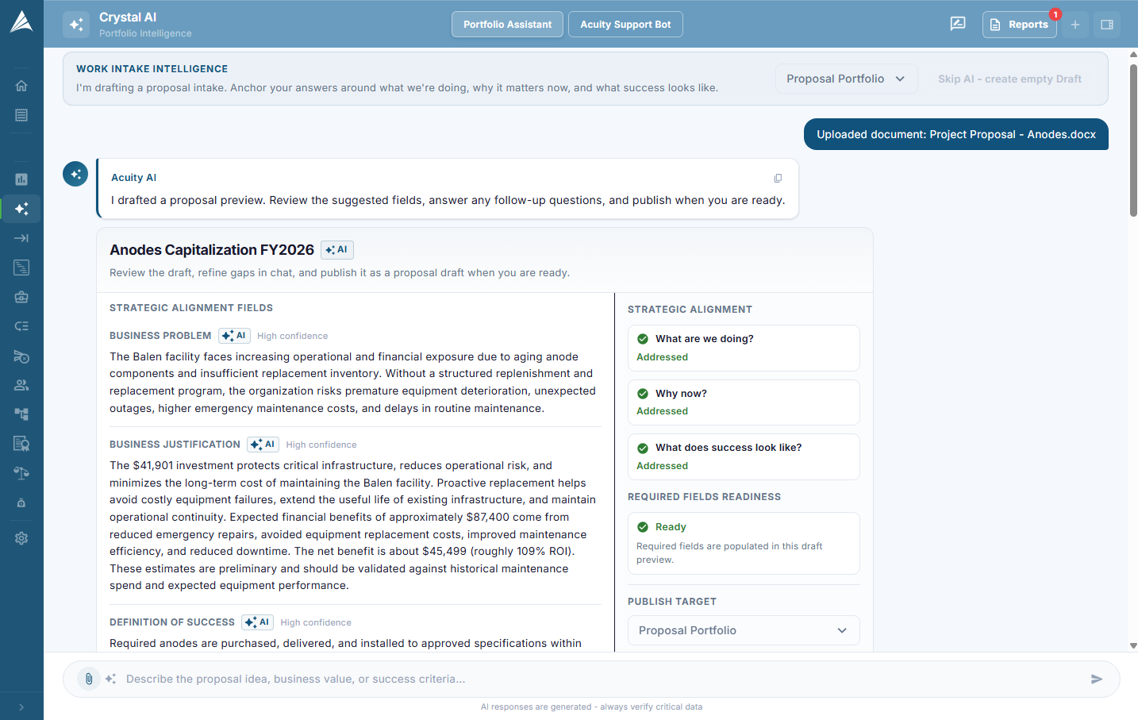
Requestors can forward or send an email to a designated intake address, and AI parses the subject, body, and attachments to create a structured intake record with the project name, description, business justification, requested timeline, stakeholders, and estimated scope. The submitter receives a confirmation with a link to review and refine what the AI extracted. For users who prefer a direct interface, an AI-guided form replaces the traditional fifteen-field form with a conversational experience: the requestor describes the idea in plain language and Crystal AI asks targeted follow-up questions to fill the gaps.
**Pro Tip**: before you redesign your intake form, ask your last five requestors what they found hardest about submitting. The answer often is “I didn’t know what you wanted.”
2. A complete proposal, not a partial one
Many organizations build their financial business cases in Excel. Rather than forcing re-entry into a PPM tool, Work Intake Intelligence accepts the workbook, extracts labeled financial metrics (total cost, ROI, NPV, payback, annual benefits), identifies multi-scenario models, validates the calculations, flags discrepancies, and documents the assumptions embedded in the workbook. Role-based resource estimates are drafted at the same time. Every extracted value carries a confidence score based on how clearly it was labeled and how verifiable the calculation is.
3. PMO analysis
Automated quality checks, strategic fit scoring, and routing recommendations replace the ad-hoc review most Level 1–2 PMOs perform inconsistently, and give Level 3+ PMOs portfolio composition impact and conflict detection they would otherwise assemble manually.
4. Governance review support
Summary decision packets, real-time question-and-answer during the review itself, and trade-off scenarios on demand. Governance teams stop synthesizing fragmented data in the meeting and start deciding in the meeting.
5. AI-generated draft risks
Before a proposal is approved, AI generates three to five categorized draft risks with initial risk-matrix scoring based on the proposal details, organizational context, and portfolio composition. Each risk includes a title, description, category, likelihood score, impact score, and a suggested mitigation. This is the capability I think most PMO leaders will feel immediately, because risk is the section of the proposal that is most consistently left blank or barely filled in.
6. AI-generated draft dependencies
AI compares the proposal against the active portfolio — technology stacks, target systems, shared resources, delivery timelines, existing dependency registers — and produces two to four draft dependency records. Each is classified by type (technical, schedule, resource, or information), assigned a direction (upstream or downstream), an impact level, a timing sensitivity, and a suggested coordination action. Unknown dependencies are one of the largest sources of portfolio risk, and identifying them at intake is far more valuable than discovering them mid-execution.
7. On-demand approval feasibility analysis
When a governance body is ready to decide, it can utilize a feasibility brief: priority ranking relative to approved and proposed work, value and risk drivers, known and emerging risks, historical delivery patterns for similar initiatives, current and projected resource availability, and the impact on already-approved higher-priority work. The output is a recommended approval frame — approve now, approve later, or defer — with a timing recommendation and an explanation of the trade-offs and assumptions behind it. This capability is explicitly on-demand. It is invoked when judgment is required, not run continuously.
8. Likelihood of delivery confidence
Every proposal is automatically evaluated against historical patterns — project size and type, sponsor role, dependency characteristics, capacity assumptions, and the delivery outcomes of similar past initiatives — to produce a High/Medium/Low confidence band with its contributing factors made explicit. A sample output reads: “Initiatives with similar scope, dependency complexity, and staffing assumptions historically experienced delivery challenges when approved without phased sequencing.” This is decision input, not a verdict.
9. Duplication and consolidation analysis
AI evaluates overlap against other requests in the pipeline, approved-but-not-started work, and in-flight initiatives, then surfaces duplicate detection, overlap scoring, and consolidation recommendations. In organizations without centralized visibility, duplicate requests across departments are routine. Catching them at the front door is far cheaper than discovering them at month four.
The Maturity Question: What Can a Level 1 PMO Actually Use?
This is the question every PMO Director should ask of any AI capability, and most vendors answer it badly. The honest answer depends on what the capability needs in order to be trustworthy, and it sorts into three classes.
- Augmentation — use now, at any maturity level. These capabilities run on largely self-contained inputs. The AI elicits what it needs from the request in front of it rather than depending on portfolio-wide data the organization has not yet built. Guided proposal drafting, risk generation, and dependency identification all sit here.
- Data-gated — wait for the data. Delivery Confidence runs on external benchmark patterns at low maturity and sharpens into something statistically grounded as your own delivery history accumulates.
- Action-gated — wait for the organization to act. The “approve later” and “defer” frames inside feasibility analysis are only as valuable as leadership’s willingness to actually stage or defer work. The analysis is sound at any maturity level; the payoff requires a governance team that will act on it.
Work Intake Intelligence is overwhelmingly an augmentation-class pillar, and that is precisely why it is the right place to start. Its value is highest at low maturity. The work it performs — helping every requestor produce a complete, strategically aligned proposal — is work nobody on a lean team performs at all today.
The persona that makes this concrete is the experienced PMO Director who has just stepped into a Level 1 organization. They have the judgment. What they lack are the Analysts, the governance structure, and the reporting to act on it. Work Intake Intelligence is the front-door half of the PMO team you don’t have yet — supplying the proposal-writer and the risk analyst the organization structurally lacks, so that Level 3 judgment finally has well-formed work to operate on from day one.
What Work Intake Intelligence Does Not Do
Clear boundaries matter more with AI than with any other capability, because ambiguity about what the machine decides is what erodes governance trust. Work Intake Intelligence:
- Does not score or rank projects against each other — that is Prioritization Intelligence.
- Does not place projects on a roadmap or timeline — that is Portfolio Planning Intelligence.
- Does not determine whether the organization has the people to deliver — that is Resource Capacity Intelligence.
- Does not perform portfolio-level risk aggregation or contagion analysis — that is Strategic Risk Intelligence.
- Does not auto-approve, auto-reject, or automatically merge duplicate proposals. Every AI-generated risk and dependency is created in Draft status and stays there until a Project Manager or PMO Director validates, edits, or dismisses it.
- Does not block or delay submission. All outputs are advisory, explainable, non-binding, and fully overridable.
Governance decisions stay with the governance team. The AI’s job is to make sure that when the team decides, they are deciding with the complete picture in front of them.
Work Intake as the Assembly Point
Work Intake Intelligence is where the other pillars converge. Prioritization Intelligence supplies the ranking and value context. Resource Capacity Intelligence supplies feasibility confidence. Portfolio Planning Intelligence supplies timing and sequencing implications. Strategic Risk Intelligence supplies the portfolio-level risk context that enriches the project-level risk profile generated at intake. Governance teams receive one unified, decision-ready artifact at the moment of decision instead of four separate analyses delivered at four different times.
The relationship also runs in the other direction, and this is the part most people miss. Because Work Intake is augmentation-class and usable from Level 1, every well-formed proposal it produces becomes the intake, performance, and capacity data that the data-gated pillars require. A drafted proposal is intake data. An AI resource estimate is capacity data. Each turn of the intake crank generates the conditions that make the next tier of portfolio reasoning of higher quality as well as trustworthy.
Work Intake is the pillar you switch on first, and it is the pillar that opens the data gates the rest of the architecture is waiting on.
Summary
- Work intake (demand management) determines the composition of the portfolio; it is the highest-leverage decision point in project portfolio management.
- The intake problem is not merely about which form gets submitted. It is that requestors lack project and portfolio management fluency and PMOs commonly lack analyst capacity.
- Work Intake Intelligence covers nine steps, from frictionless capture through risk, dependency, feasibility, delivery confidence, and duplication analysis.
- Its value is highest at Level 1–2, because it performs work lean teams are not doing at all today.
- Everything it produces is a draft. Governance teams keep every decision.
Acuity PPM helps mid-market PMOs build a work intake process that the organization will actually use — and then puts AI behind it so that a small team can run it well. To see Work Intake Intelligence in your own portfolio context, schedule a demo below.